History
History
A random find
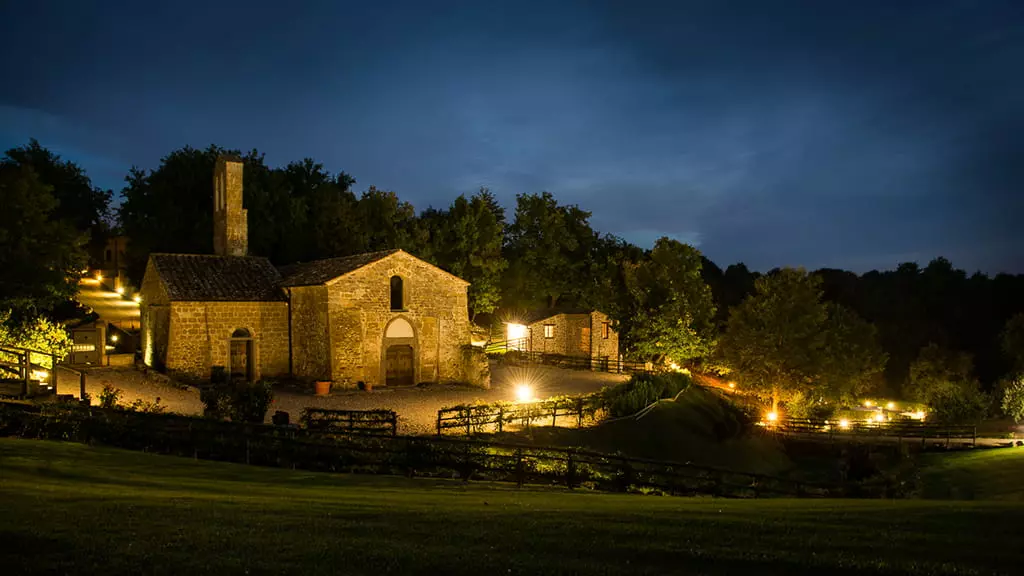
The Terme di Sorano is a recent reality, but with an ancient, indeed very ancient, heart. It is known that thermal water has been flowing in this place since time immemorial, as evidenced by the core samples carried out on site by the property in collaboration with a renowned geological studio, which have certified tens of thousands of years of deposits on the travertine found at just two meters deep. It must indeed be clarified a very curious aspect about the terrain configuration of this area, known for the tuff towns such as Sorano, Pitigliano, and Sovana, while the hill overlooking the spring is the only one in the area made of a different stone, travertine, a result of calcium deposits that, thanks to the core sampling, have allowed to trace back the existence of the thermal spring to thousands of years ago. Certainly known to the Etruscans and Romans, the spring around the year 1000 was widely exploited, as evidenced by the Pieve that was built here by the Aldobrandeschi, a comital family that owned these lands and that found relief in these waters several times. Already Pope Gregory VII around the year 1000 came to these waters to bathe. The Pieve remained operational until the middle of the last century, when the Diocese of Pitigliano decided to close it, and with it the epic of the thermal baths which within a few years were abandoned until they were swallowed up by the vegetation. To rescue from abandonment both the ancient Pieve and the very ancient baths, whose spring over time was presumably lost following the extraction of travertine stones from the hill (in the ’60s even with explosions) that led to the destruction of that spring, there was a random event. In December 2000, in fact, Mr. Calvani, an enthusiastic truffle hunter with his faithful companion Diesel, a mixed-breed (Lagotto/Irish Setter) with an exceptional sense of smell, were in that place looking for truffles when the dog’s attention was fixed on a spot on the ground in the valley floor where, not by chance, there was a truffle, a black truffle. The search was not easy because it was under a large stone that, with some difficulty, he managed to move until the truffle emerged. The surprise, however, was not so much in finding the truffle, but in noticing a stream of water that was emerging from the ground and soon evaporated. It was definitely hot water. Interested in the event, Mr. Calvani collected some of that hot water using an empty bottle found on site which, once analyzed by a chemist friend who worked at an analysis center, was discovered to be thermal water rich in minerals. From this moment on, the thermal life of this place was revived, with the Pieve at the center of the current complex that was restored and that today is a state-of-the-art thermal center appreciated by all the clients who have discovered it in these 16 years. The official opening indeed took place in 2006, following many renovation works that allowed not only the ancient baths to be brought back to life but also the old Pieve, with an intervention faithful to the pre-existing structure. A magical place, rich in history and pagan water cults, where the common denominator has always been the well-being of the body and mind.